
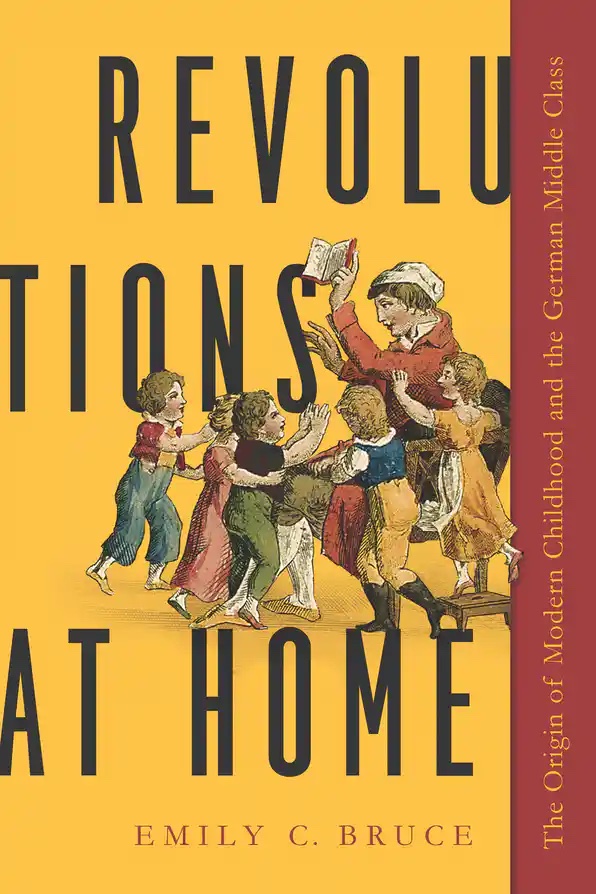
My first book, Revolutions at Home: The Origin of Modern Childhood and the German Middle Class, was published in July 2021 by the University of Massachusetts Press through the Childhoods: Interdisciplinary Perspectives on Childhood and Youth series.
How did we come to imagine what “ideal childhood” requires? Beginning in the late eighteenth century, German child-rearing radically transformed, and as these innovations in ideology and educational practice spread from middle-class families across European society, childhood came to be seen as a life stage critical to self-formation.
This new approach was in part a process that adults imposed on youth, one that hinged on motivating children’s behavior through affection and cultivating internal discipline.
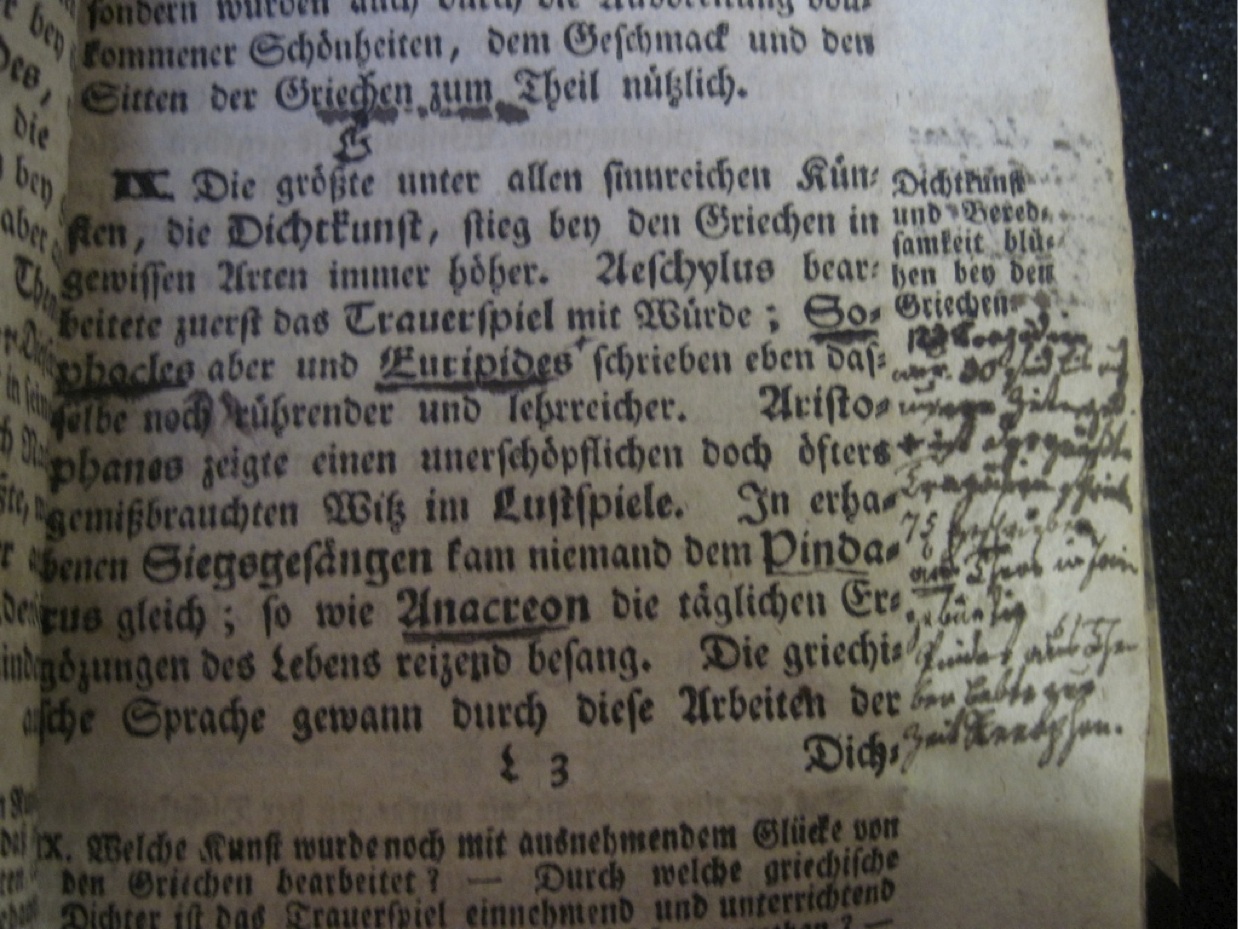
But this is not just a story about parents’ and pedagogues’ efforts to shape childhood. Offering rare glimpses of young students’ diaries, letters, and marginalia, I reveal how children themselves negotiated these changes.
Revolutions at Home analyzes a rich set of documents created for and by young Germans to show that children were central to reinventing their own education between 1770 and 1850.
Through their reading and writing, they helped construct the modern child subject. The active child who emerged at this time was not simply a consequence of expanding literacy but, in fact, a key participant in defining modern life.

Bruce’s work is especially valuable for the clear view it provides readers on sources and forms of analysis needed in the history of childhood and children. Each chapter challenged the view that children did not participate or have agency in the new literary culture of the nineteenth century. The book is an excellent model for readers seeking to learn how to examine histories of children’s experiences and childhood across a range of geographic and temporal periods.
– Review by Nisrine Rahal for Histoire Sociale/Social History
Her in-depth analysis can be read as a tutorial on how to conduct nuanced readings of various primary sources ranging from periodicals to diaries. This type of instruction in close reading, especially on a micro level, is valuable for seasoned scholars and novice students alike. For anyone looking to educate themselves on the history of childhood and class in nineteenth-century Europe, Bruce’s monograph will not disappoint.
– Review by Alexandria Ruble for H-German
This well-written and easy-to-read study makes a sound contribution to the historical scholarship about the nineteenth-century German family and childhood as well as educational practices often tied to gender. Scholars in the field will enjoy some of its details; more- over, anyone generally interested in this topic would find it interesting as well….The most original contribution involves the children’s sources, which provide access to how these youthful writers digested what their parents or tutors wanted them to learn and how they reacted to these experiences.
– Review by Joanne Schneider for Central European History
Crucially, the author considers reading and writing not only as acts of consumption and/or instruction. Her analysis captures not only the purpose of pedagogy but also the potential for children and youth to practice forms of subjective subversion. Bringing together texts and contexts that include canonical, formative narratives, such as fairy tales, with original archival research into letters and diaries written by young authors, Revolutions at Home adds dimension to the scholarship in childhood studies by identifying the bildungsbürgerlich processes that endow children and youth with agency.
– Review by Patricia Anne Simpson for The German Quarterly
In “Telling Tales,” arguably the strongest chapter in the book, the author works with the well-known fairy tales collected by the Grimm brothers. Here, Bruce develops her argument about the major role reading played for the emergence of class-based subjectivities of modern childhood. She goes to great lengths in compar- ing different versions of the stories and traces the strategies that connect children to both family and class and prescribe certain desirable qualities in a child. It becomes clear how much the Grimm tales prefer and propagate the biological family.
– Review by Martina Winkler for The Children’s Literature Association Quarterly
It is anchored in geography and time (Germany after the Enlight- enment and before unification) but linked to cross- border networks showing the flow of ideas. It seeks to understand how young German writers saw them- selves (modeling Ranke) while constructing a gene- alogy of childhood (modeling Nietzsche) that sheds light on our own preconceptions about raising mod- ern children. It hints at the fascinating connections between children’s autonomy and capitalist economic systems (think of social media in the twenty-first century) that are worthy of careful analysis. This sophisticated text is a worthwhile read for Germanists specializing in childhood, consumer culture, and/or pre-unification Germany. It is accessible enough for specialists of other geographic foci (the United States, France, the United Kingdom) interested in childhood.
– Review by Bryan Ganaway for the American Historical Review
Bruce compellingly demonstrates how German pedagogues, authors of children’s tales, and children themselves constructed a new ‘childhood subjectivity.’ This study will appeal to readers interested in the histories of childhood, education, and German middle-class identity, as well as anyone curious about the origins of classics like Grimm’s fairy tales.
– Anna Kuxhausen, author of From the Womb to the Body Politic: Raising the Nation in Enlightenment Russia
A new and valuable contribution to the growing literature on children’s literacy and writing.
– Andrea Immel, author of Childhood and Children’s Books in Early Modern Europe, 1550–1800

The research for Revolutions at Home was generously supported by:
- The University of Minnesota: Imagine Fund and Faculty Research Enhancement Funds
- The National Academy of Education / The Spencer Foundation: Dissertation Fellowship, 2012-2013
- Deutscher Akademischer Austausch Dienst (German Academic Exchange Service): Research Grant, 2011-2012
- The Conference Group for Central European History
- The University of Minnesota Graduate School (2007-2008, 2010-2011), College of Liberal Arts, History Department, and Center for German & European Studies (Hella Mears Graduate Fellowship in European Studies, 2012)
- The Friends of the Princeton University Library: Research Grant, 2011
Revolutions at Home is based on documents from state and city archives across Germany. It also draws on the holdings of libraries with extensive collections of books published for children and youth. Here are links to some of those institutions:
Historical Collections of Children’s Books
- Kinder- und Jugendbuchabteilung, Staatsbibliothek Berlin (Children’s and Young People’s Literature Department, State Library Berlin)
- Cotsen Children’s Library: Princeton, NJ
- Bibliothèque l’Heure joyeuse (Library of the Joyful Hour): Paris, France
- Georg-Eckert Institut für Internationale Schulbuchforschung (Georg-Eckert Institute for International Schoolbook Research): Braunschweig, Germany
- Bibliothek für Bildungsgeschichtliche Forschung (Research Library for the History of Education): Berlin, Germany
- Institut für Jugendbuchforschung (Institute for Youth Literature Research): Frankfurt, Germany
- ALEKI – Arbeitsstelle für Kinder- und Jugendmedienforschung (Center for Children’s and Young Adult Media Research): Cologne, Germany
 Emily C. Bruce, Ph.D.